Two quantitative researches in the history of philosophy. Some uphazard methodological reflections

¶ 1 Leave a comment on paragraph 1 0 This post is the third of a series of contributions to the DR2 Conference.
¶ 2 Leave a comment on paragraph 2 0 Comments are welcome! (How to comment)
¶ 3 Leave a comment on paragraph 3 0
guido bonino1, Paolo maffezioli2 & paolo tripodi1
¶ 4 Leave a comment on paragraph 4 0 1 University of Turin; 2 University of Barcelona
¶ 5 Leave a comment on paragraph 5 0
¶ 6 Leave a comment on paragraph 6 0 In this paper we are going to put forth some methodological reflections on two different investigations we have conducted in the context of the DR2 research group. Such investigations were our first serious attempts at applying distant reading techniques and more in general quantitative methods to the history of philosophy. A sketchy preliminary presentation of the two researches is in order as a basis for the methodological remarks.
1.two case studies in quantitative history of philosophy
1.1 Wittgenstein and academic success
¶ 7 Leave a comment on paragraph 7 0 The first investigation concerns the place of Wittgenstein in contemporary analytic philosophy. Of course, this topic has already been amply investigated by means of the traditional methods of the history of philosophy. A rather convincing historical reconstruction is largely shared within the philosophical community. The story begins in the 1950s and 1960s, when Oxford, and to a lesser extent Cambridge, were the centre of analytic philosophy, and when Wittgenstein – the later Wittgenstein – was regarded as the champion of that philosophical tendency. In the 50s and 60s the Wittgensteinian paradigm was so dominant in Britain, that many people thought that that tradition was about to have a similar impact also on the US. However, things went on differently. That happened presumably for a number of philosophical, cultural, and even geopolitical reasons. Let us just say that the Wittgensteinian tradition has been largely forgotten or rejected by present-day analytic philosophers: it has lost its centrality in Britain, and it has never reached a comparable reputation in the US.
¶ 8 Leave a comment on paragraph 8 0 That is roughly the story that many philosophers accept and that is told by historians of philosophy. The aim of our work was to check whether a quantitative approach to the history of philosophy can add some interesting details and new insights to the historical-philosophical understanding of the decline of the Wittgensteinian tradition in contemporary analytic philosophy.
¶ 9 Leave a comment on paragraph 9 0 It is important to realize that, notwithstanding the supposed decline, Wittgenstein has always remained a very important philosopher, a “classic” – so to speak – throughout the whole period under consideration, and that he has always been a very popular subject matter of PhD philosophy dissertations in the US.
¶ 10
Leave a comment on paragraph 10 0
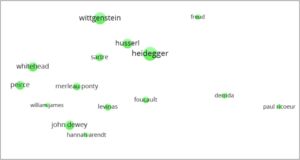 Figure 1. Names of 20th-century philosophers in the titles of US PhD dissertations (1899-2010)
¶ 11 Leave a comment on paragraph 11 0
¶ 12
Leave a comment on paragraph 12 0
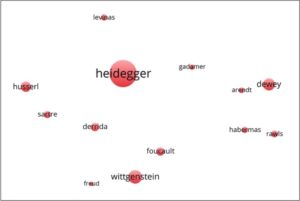 Figure 2. Names of 20th-century philosophers in the abstracts of US PhD dissertations (1981-2010).
¶ 13 Leave a comment on paragraph 13 1 We thought that one aspect of the supposed decline of Wittgenstein in the history of analytic philosophy could be investigated by analyzing the academic careers (if any) of those who wrote their dissertation on Wittgenstein, and by comparing them with the careers of those who wrote their dissertation on a “typical” analytic philosopher. In particular, we chose four analytic philosophers, who hold very different views on virtually every subject, but who are almost unanimously regarded as important figures within the analytic community. They are David Lewis, Saul Kripke, Michael Dummett and Jerry Fodor.
¶ 14 Leave a comment on paragraph 14 0 The first step of the work was that of selecting the philosophy dissertations defended from 1981 to 2010. Then we selected those dissertations in which the name ‘Wittgenstein’ occurs in the abstract. Thus we got 329 dissertations. The same was done with the “analytic” dissertations (we got 404 of them). Then we traced the academic careers (if any) of all the authors of dissertations that had been selected. We attributed a numerical value to the highest position each of them held (if any). We took into account both the academic rank (adjunct, assistant, associate, full professor) and the ranking of the philosophy department (we used a rather rough ranking, based on three levels, and drawn from existing rankings). Then we calculated the average value for each group: this is what we called the Academic Success Index. Figure 3 shows the comparison between Wittgensteinian and analytic dissertations.
¶ 15
Leave a comment on paragraph 15 0
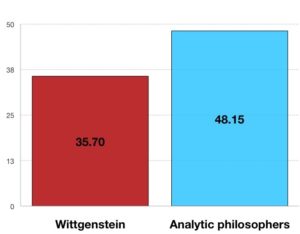 Figure 3. Analytic philosophers: +35%
¶ 16 Leave a comment on paragraph 16 0
¶ 17 Leave a comment on paragraph 17 0 As you can see, there is a significant difference between the two groups. The Wittgensteinian “decline” seems to be in some way confirmed. The relatively low Academic Success Index is a manifestation of such a decline.
¶ 18 Leave a comment on paragraph 18 0 It must be remarked that the Academic Success Index, given the somewhat arbitrary way in which the different factors are weighed, should not be taken too seriously as an absolute value. However, we think that it represents a significant indicator, if it is considered in a comparative way. What makes us confident that the result is rather solid is that we considered other groups of dissertations and made other comparisons, and all of them converge toward its confirmation. More or less the same results can be obtained whether you consider the whole period 1981-2010 or rather the disaggregated data for five-year periods, whether you focus on strictly Wittgensteinian theses or you take into account also those in which Wittgenstein is a minor topic, whether you normalize the Academic Success Index for academic age or not, etc.; moreover the Academic Success Index of Wittgenstein is low not only with respect to typical analytic philosophers, but also with respect to some other groups of dissertations we chose as control groups: Gadamer, Spinoza and a random sample of the dissertations.
¶ 19
Leave a comment on paragraph 19 0
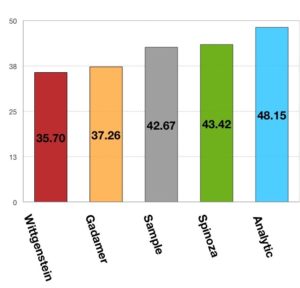 Figure 4. Academic Success Index of Wittgenstein compared with other groups.
¶ 20 Leave a comment on paragraph 20 0
¶ 21 Leave a comment on paragraph 21 0 What does all that mean? Everybody knows that correlation is not causation. The fact that those who write a dissertation on Wittgenstein are less likely to enjoy academic success with respect to those who write their dissertation on a typical recent analytic philosopher (or on Spinoza, for that matter) does not by itself mean that the choice of the subject matter of their dissertation is in any way a cause of their not so brilliant career. We tried in our work to show, by means of different comparisons of data, that the choice of the subject matter is at least a genuine cause, among others, of the difference in academic success.
¶ 22 Leave a comment on paragraph 22 0 But why, and how, does a philosophical topic make a difference for academic success? Using a visualization software, we found this.
¶ 23 Leave a comment on paragraph 23 0
¶ 24
Leave a comment on paragraph 24 0
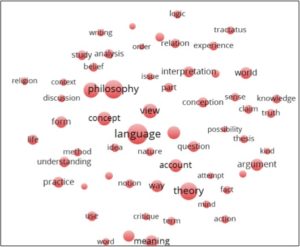 Figure 5. Wittgenstein.
¶ 25 Leave a comment on paragraph 25 0
¶ 26
Leave a comment on paragraph 26 0
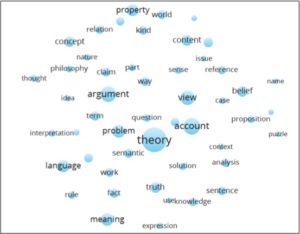 Figure 6. Analytic philosophy.
¶ 27 Leave a comment on paragraph 27 0
¶ 28 Leave a comment on paragraph 28 0
¶ 29 Leave a comment on paragraph 29 0 These maps have been obtained by retrieving and counting the occurrences of terms in the abstracts of the theses. The size of an item’s label and the size of an item’s circle depend on the number of occurrences of the item.
¶ 30 Leave a comment on paragraph 30 1 Looking at the analytic map, we found a pattern that we did not recognize in the Wittgensteinian one. The keywords on the map (that is, the biggest blue circles), suggest the idea that philosophy is a kind of theory – ‘theory’ is the main keyword – which provides arguments, gives accounts, defends claims, in order to solve problems. Theory, argument, problem, account, claim: these are all important keywords on the analytic map. It is a pattern that alludes to a science-oriented style and metaphilosophical view.
¶ 31 Leave a comment on paragraph 31 0 To sum up the present results: it seemed to us that the difference of academic success may be (partly) explained by the presence (and the absence) of certain semantic patterns; such patterns, in turn, point to the presence (and the absence) of a science-oriented philosophical style and metaphilosophy. Therefore this is perhaps our main thesis: the index of academic success for PhD candidates in US philosophy departments in the last forty years is quite strictly connected to the choice of a more or less science-oriented philosophical style and metaphilosophy.
¶ 32 Leave a comment on paragraph 32 0 Did our quantitative research add anything original to the picture of the decline of Wittgenstein provided by historians of philosophy by means of traditional methods? We think so. We have retrieved, measured, read and interpreted a relatively large amount of data, and by examining the data we have pointed out the metaphoric place where the decline of Wittgenstein began. It is up there, so to speak, in the very same place in which the process of academic recruitment takes place. Our results seem to suggest that the decline of Wittgenstein, which at least in part depends on the choice of a certain topic for the PhD dissertation (a topic more or less associated to science-oriented philosophical style and metaphilosophy), is not due, so to speak, to a widespread Zeitgeist. If a philosopher is simply out of the Zeitgeist, or against the tide of history, it is likely that people cease to speak of his work: for example, PhD students would probably write few dissertations on him. Here we have to do with a different phenomenon: the decline of Wittgenstein seems to be a consequence of a top-down process, or better: of a process driven from the top, a process guided by a relatively small number of people, i.e. those academics who hold the power of influencing the recruitment policies in the philosophy departments. Of course, this remark is nothing but a suggestion. More work should be done, and more data should be analysed, in order to make the suggestion a solidly confirmed hypothesis. However, it is not an airy-fairy suggestion either.
1.2 Logic in analytic philosophy
¶ 33 Leave a comment on paragraph 33 0 The aim of our second work was that of substantiating with data the widely shared view according to which logic has become increasingly central in analytic philosophy. The corpus taken into consideration comprises all the articles published in five important philosophical journals (The Journal of Philosophy, Mind, The Philosophical Review, The Proceedings of the Aristotelian Society and Philosophy and Phenomenological Research) in the time span 1941-2010.
¶ 34 Leave a comment on paragraph 34 0 To give a concise anticipatory overview, we provided some results concerning the overall presence of logic in these articles, the relative technical sophistication of the logic used for philosophical purposes, the kind of use that is made of logic (i.e., subject matter vs. instrumental). Our guiding questions were: What are the relations between analytic philosophy and logic? What is the role of logic in analytic philosophy? Would you need logic to do analytic philosophy?
¶ 35 Leave a comment on paragraph 35 0 The common opinion is that logic is very important in analytic philosophy. However, to understand better what the role of logic in (analytic) philosophy is, it seemed interesting to us to investigate how much logic and what kind of logic is present in philosophy, and how it is used. Distant reading and, more generally, quantitative methods allowed us to find more interesting and reliable answers to such questions.
¶ 36
Leave a comment on paragraph 36 0
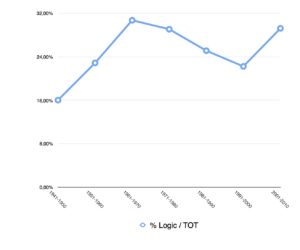 Figure 7. How much logic? Percentage of articles in which logic is present in some way.
¶ 37 Leave a comment on paragraph 37 0
¶ 38 Leave a comment on paragraph 38 0 By distantly or – as Moretti once said – serially reading all the articles in which logic is in some way present, for each paper we raised the following two questions. Q1: What does this paper use logic for? Q2: What level of logical competence does this paper require? In answering Q1, we distinguished an instrumental and a non-instrumental role of logic in philosophy. By non-instrumental uses we mean either doing logic properly understood (= giving proofs, demonstrating theorems, and so forth) or dealing with logic as a subject matter of philosophy (= investigating the philosophy of logic). Instrumental uses are those that can be found in articles in which the role of logic is that of providing an instrument for philosophy: logic as an instrument for doing moral philosophy, metaphysics, epistemology, and so forth. A third category (“Other”) includes history of logic and inductive logic.
¶ 39
Leave a comment on paragraph 39 0
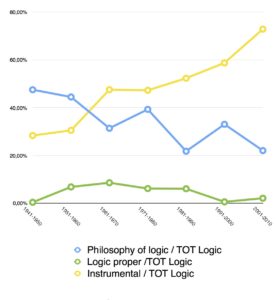 Figure 8. What kind of logic?
¶ 40 Leave a comment on paragraph 40 0
¶ 41 Leave a comment on paragraph 41 0 Logic as an instrument increases over time, logic as a discipline does not: philosophy of logic decreases and logic proper remains constant (with negligible numbers). The common opinion seems to be confirmed by data, but it does not tell the whole story.
¶ 42 Leave a comment on paragraph 42 0 Even with respect to Q2, we wanted to find an answer as precise and complete as possible. In order to get to such an answer, we proposed a method to measure the level of “logical sophistication”. We have represented in a map the most relevant topics in logic, from logical preliminaries to Gödel’s incompleteness theorem, so to speak. The map is based on a comparative analysis of the table of contents of ten well-known logic textbooks and online courses. Technically, the map consists in a graph with nodes labelled by logical topics and arrows connecting the nodes. The nodes are the following:
Preliminaries: prel

Propositional logic: pl

Propositional modal logic: pml

Non-classical propositional logics: ncpl

First-order logic: fol

Peano arithmetic: pa

Proof theory: pt

Second-order logic: sol

Model theory: mt

Set theory: st

First-order modal logic: foml
¶ 43
Leave a comment on paragraph 43 0
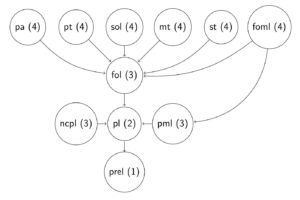 Figure 9. Graphic representation of kinds of logic and their relations.
¶ 44 Leave a comment on paragraph 44 0
¶ 45 Leave a comment on paragraph 45 0 The numbers represent the level of difficulty (e.g. prel is less difficult than fol, or pt is as difficult as mt). Notice there is also a level 0: no competence of logic at all. Then for each article we asked: How much logic would you need to have a fair grasp of the article itself? Figure 10 is a summary of the results.
¶ 46
Leave a comment on paragraph 46 0
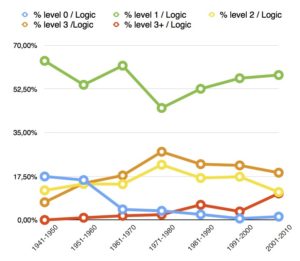 Figure 10.
¶ 47 Leave a comment on paragraph 47 0
¶ 48 Leave a comment on paragraph 48 0 Level 0 (no logical competence at all) disappears in the 60s. Level 1 is largely the most significant (55,77%) and it increases regularly. Level 2 and 3 increase moderately. Level 3+ also increases, but only in the last decade.
¶ 49 Leave a comment on paragraph 49 0 Thus, how much logic is present in analytic philosophy? Approximately 25% of all the articles in the corpus. What use of logic is made in analytic philosophy? Logic is mainly instrumental. What is the level of logical sophistication in analytic philosophy? The average level of difficulty does not go beyond preliminaries. How should these results be interpreted? Do they confirm the centrality of logic in analytic philosophy? Are they in some way unexpected? These are difficult questions, and they certainly require serious reflection. Yet it seems to us that also in this case distant reading has provided at least the raw material for such reflections.
2. Some considerations
¶ 50 Leave a comment on paragraph 50 0 Some methodological considerations can be addressed concerning the two studies described above. They concern three main issues: the motivation for quantitative analysis; the kinds of data and corpora; the application of human distant reading as opposed to computer-assisted distant reading.
2.1 Question-driven investigations
¶ 51 Leave a comment on paragraph 51 0 The origin of both studies lies in specific research questions, which are raised in the context of traditional history of (analytic) philosophy, and by the conviction that it would be difficult to answer such questions by applying non-quantitative methods.
¶ 52 Leave a comment on paragraph 52 0 The first set of questions concerns the place of Wittgenstein in contemporary analytic philosophy or, perhaps more precisely, the relationship between two philosophical traditions, the analytic and the Wittgensteinian. Part of this story – the story of the decline of the Wittgensteinian tradition in analytic philosophy from the 1960s to the 1980s – has already been written. According to such “received view”, the influence of Wittgenstein’s philosophy has been declining in the last decades for many different reasons: the predominance of American analytic philosophy over British analytic philosophy; the scientific, rather than humanistic, self-understanding of analytic philosophy in the United States; the misleading association of Wittgenstein to (the declining tradition of) logical positivism; the success of Quine’s anti-Wittgensteinian argument for the continuity between philosophy and the natural sciences; the widespread view, among analytic philosophers, according to which Wittgenstein’s a-theoretic metaphilosophy is untenable; several anti-Wittgensteinian arguments about language and mind defended by analytic philosophers such as Hilary Putnam, Donald Davidson, J.J.C. Smart, Jerry Fodor and some others; the rise of cognitive sciences; the return of metaphysics fostered by Saul Kripke and David Lewis, and so forth.
¶ 53 Leave a comment on paragraph 53 0 Given this multifaceted explanation, however, many questions are still open and wait for an answer. For instance, we speak of a decline of Wittgenstein’s philosophy, but what was the pace of such a decline? Are there ways in which one can estimate this pace? Is a comparative evaluation of the different causes of the decline possible? In what areas of philosophical production did the decline begin? In general, is it possible to measure the decline in any significant way?
¶ 54 Leave a comment on paragraph 54 0 It was quite natural, for us, to think of the application of quantitative methods, in order to tackle such questions, as we assumed that analytic philosophy is a paradigm case of academic philosophy and that, consequently, part of the answers could be found in the sociology of academia. Luckily Proquest provides the metadata of 30,000 US PhD dissertations in philosophy (1899-2015). As the choice for a subject matter of a dissertation is usually sensitive to fashions and trends, we thought that this corpus was not only interesting and worth exploring in itself, but it could be the right place to look at, in order to answer our remaining questions. Preliminarily, however, we had to enrich the corpus with newly acquired data: in particular, the data concerning academic careers. Then we analysed the data in the way described above.
¶ 55 Leave a comment on paragraph 55 0 The second group of questions was addressed because of the need to clarify and test a widespread but vague view about the presence and role of logic in analytic philosophy. Many people seem to take it for granted that there is very much logic in analytic philosophy, that the role of logic in analytic philosophy is crucial, perhaps even constitutive, and that many or perhaps most analytic philosophers are logically sophisticated thinkers. However, this view is based on impressions rather than on scientific evidence. Hence in this study it was as natural as in the previous case to rely upon quantitative methods, with a twofold aim: (i) to explicate the vague, impressionistic view about logic in analytic philosophy; (ii) to test it, thus providing a well-grounded confirmation or disconfirmation of it.
¶ 56 Leave a comment on paragraph 56 0 It seems to us that historians of philosophy and historians of ideas should be aware that generalisations in their disciplines (and, more in general, in the humanities) are methodologically awkward and take too often the form of unjustified statements.
¶ 57 Leave a comment on paragraph 57 0 Working as a traditional historian of philosophy, what are the evidences you can rely on to support the story about the decline of Wittgenstein in the history of analytic philosophy, or the idea that logic plays a crucial role in analytic philosophy? You can rely on a fair number of articles and books, which are supposed to have played an important role in this story. Maybe the number of articles and books taken into consideration is quite big, if you are an avid reader, but in any case you can read with the due attention only a small part of the whole philosophical production that may be relevant, especially if you are also interested in what happened in recent years, when the academic production has exponentially grown. Second, you can rely on your more or less well-established personal impressions about what happened, derived from your familiarity with the subject matter or the relevant philosophical milieu. Alternatively, you can rely on the impressions of other actors of the history you are trying to reconstruct: typically, semi-autobiographical reflections of important philosophers who played some role in the events. Probably, these evidences are reliable enough to write a history that is approximately correct. Yet many details still elude the historical reconstruction.
¶ 58 Leave a comment on paragraph 58 0 In both cases our research was guided by problems and questions that emerged in our own previous work. It has to be emphasised that a question-driven approach can be very burdensome and, in a sense, uneconomical. If for example your starting point is, as in our case, a precise question concerning the relation between philosophic academia and in particular the recruitment policies, on the one hand, and the developments in analytic philosophy in America, on the other hand, it is likely that you cannot find an easy and more or less ready answer in some preconstituted dataset that is already available. Thus, for example, as we will tell below more extensively, you have to build your corpus from scratch, starting with raw materials and enriching them; specific data can perhaps answer your question, but you have to work hard to obtain those very data, and this can cost you a lot of time and work. This has been our experience in the study on Wittgenstein and analytic philosophy: more than two years of preliminary work before we could start with our analysis and interpretation.
¶ 59 Leave a comment on paragraph 59 0 On the other hand, however, such a question-driven approach has also many merits, and it seems to us that it can be advantageous even from the point of view of the digital humanities, for three main reasons.
¶ 60 Leave a comment on paragraph 60 0 First, without a solid theoretical apparatus, strictly data-driven investigations are blind, and run the risk of being nothing but the curiosity-driven exploration of an available corpus (this, of course, can be an interesting and even pleasant task, but it is less likely to provide interesting results in the humanities than the question-driven approach): it seems to us that Moretti’s own work is an excellent example of an extremely ambitious question-driven approach.
¶ 61 Leave a comment on paragraph 61 0 Second, dealing with huge amounts of data is a risky task in itself, because the chance of finding random or illusionary correlations is quite high: a possible antidote is to work within domains, which we are already well-acquainted with; this would make the interpretation of data easier and more solid, and this is still a fundamental task, even in so-called data-driven research.
¶ 62 Leave a comment on paragraph 62 0 Third, a question-driven approach can help to avoid a possible shortcoming, which is not unusual in the recent history of the digital humanities: the impression, from the disciplinary point of view (that is, from the point of view of the history of philosophy, the history of ideas, but also, say, of literary criticism) of beating around the bush methodologically, so to speak. In other words, it seems to us that in recent years the method-driven approach in the digital humanities has shown its shortcomings, in particular its poor results from the point of view of the humanities: if your main aim is to develop methods, it is not surprising that you pay little attention to having solid results in the humanities. Our suggestion is that if distant reading and data-driven research are first of all motivated by the wish to answer substantial questions, it becomes easier to avoid such possible shortcomings. Obtaining results that are interesting from the point of view of the traditional humanities is, at least in some cases, the deserved reward for an extremely long and costly research work.
¶ 63 Leave a comment on paragraph 63 0
2.2 Varieties of data and corpora
¶ 64 Leave a comment on paragraph 64 0 The kinds of data we analysed in the two studies are very different from one another. Those which are taken into account in the work on logic in analytic philosophy are more traditional: they are just texts. As everybody knows, the relevant texts are to be found in philosophic journals, since analytic philosophy tends to mimic the natural (especially the biomedical) sciences in regarding articles rather than books as the standard scientific format. However, which journals should we include in our corpus? There are, of course, many possible criteria for the selection: citations, rankings, etc. However, in this case we felt confident enough, as domain experts, to select the five journals on the basis of our specific competence in this area; it seems to us that the selected journals are unanimously considered representative of analytic philosophy, and we also find it irrelevant whether all of them have always or in the considered time span being regarded as the most important ones.
¶ 65 Leave a comment on paragraph 65 0 The texts were made available by J-STOR, but they were too many (over ten thousands articles) to be read, even in a serial way and from a distant perspective. Therefore we decided to focus on two sub-corpora. The first dataset is a heterogeneous purposive sample, which includes 20% of the entire corpus (approximately, 2500 articles): for each year we selected and read one journal, rather than five, with a random rotation. This sample allowed us to investigate the corpus in each decade from the 1940s to the 2000s. It seems to us that there are no ground to suppose that the sample is biased. The second sub-corpus includes all the 1731 articles which have the value ‘Logic’ in the subject field provided by the Philosopher’s Index (https://philindex.org). After eliminating manually the false positives, there were 1622 articles left. Why did we combine the two different sub-corpora? Basically, because each of them provides a different kind of information. The former allows a coarse-grained level of analysis (which is more reliable), the latter a finer-grained investigation (which allows an analysis of relevant subcorpora concerning different philosophical sub-disciplines). Thus, they integrate well with one another.
¶ 66 Leave a comment on paragraph 66 0 The research on the decline of Wittgenstein is mainly based on metadata, rather than on texts: the metadata of the PhD dissertations in philosophy defended in the United States from 1899-2015. The metadata the author of the dissertation, the title, the year of publication, the name of the supervisor, the university, the department, the abstract, some keywords, and some further information. These are very different kinds of data from texts, though both of them are, so to speak, readable entities: however, we didn’t read the dissertations themselves, rather we read their titles and abstracts. And then, of course, we also had to enrich the corpus by adding a crucial information that was missing, i.e., the subsequent career of the PhD candidates, thus integrating our dataset with what could be regarded as sociological data.
¶ 67 Leave a comment on paragraph 67 0 Moreover, since Britain was the former core of analytic philosophy, but then became more peripheral, when the core moved to the United States, it would have been extremely interesting for us to make a comparison between US and UK dissertations. This purpose required some additional work as well. The set of UK doctoral theses are collected by the Electronic Theses Online Service (EThOS). When searching for philosophical theses in the EThOS dataset (i.e., those theses with ‘Philosophy’ in the dc:subject field) we discovered that not all the retrieved records are actually related to philosophy, but sometimes to related disciplines such as sociology, religion, psychology, etc. Moreover, in some cases the subject field is empty, or it contains numbers or noisy information. The thesis subject may be of little relevance in this setting because in UK there is no clear and univocal administrative classification of PhD titles according to disciplines.
¶ 68 Leave a comment on paragraph 68 0 Happily enough, a team of computer scientists created for our purposes a system aimed at solving the problem of discriminating philosophical documents from documents of other disciplines. The attempt is based on the combination of a standard learning approach with a semantic one (as illustrated in Carducci et al., “Semantically Aware Text Categorisation for Metadata”, in Manghi et. al. (eds.), Digital Libraries. Supporting Open Science, Springer, 2019).
¶ 69 Leave a comment on paragraph 69 0 The work on logic is a typical or even literal case of distant reading, in the original sense suggested by Moretti, who also used to speak of serial reading: indeed, we serially read the journals; actually, we didn’t properly speaking read them, but we rapidly browse them. The work on Wittgenstein and analytic philosophy, on the contrary, is different in kind: the nature of the data – bibliographic metadata and sociological data – requires a different kind of quantitative analysis, rather than the application of distant reading as originally understood. It seems to us that this latter work, however, shows something that is true of quantitative methods in general, namely, that taking a distant perspective invites (though by no means forces) one to take an external approach to the history of philosophy. This is one further reason why we appreciate a distant reading approach very much, but that may be a matter of personal inclinations.
¶ 70 Leave a comment on paragraph 70 0
2.3 human distant reading
¶ 71 Leave a comment on paragraph 71 0 In both studies, computer-assisted techniques would not be suitable for the required tasks. Therefore in both cases we have deliberately decided to stick to Moretti’s original method, which might be called “manual” or “human” distant reading. In the study on the decline of Wittgenstein, we reconstructed the academic careers of each PhD student in our corpora by using “manually” a search engine. As far as we know, there is no computational tool available to fulfil this task yet, though it is not unthinkable to build one in the next future (incidentally, REPOSUM, one of the projects in which our group is involved, aims among other things to take some steps in this very direction).
¶ 72 Leave a comment on paragraph 72 0 Nor are there computational tools that are able to check whether there is logic in a given philosophic text, let alone whether the role of logic is instrumental or non-instrumental, or what the level of logical sophistication is. Of course, some argument mining projects are growing up (and we ourselves have in mind to promote one), yet current softwares do not seem to be reliable enough for our purposes.
¶ 73 Leave a comment on paragraph 73 0 Take, for example, the task of classifying instrumental and non-instrumental articles. The category of “instrumental” is very important for our analysis, since it is a fundamental component of our explication of the prevailing view, the widespread but vague picture concerning the presence and role of logic in analytic philosophy. Qua instrument, logic spreads throughout the entire body of philosophy, and this seems to make sense and explicate the prevailing view. We provided some criteria for instrumentality: an article is instrumental if (i) logic is present in it, and (ii) it is not pursued for its own sake, but to tackle a specific philosophical problem; moreover, (iii) such a philosophical problem is not a problem directly and exclusively triggered by a philosophical reflection on logic. At the same time, however, we left some room for intuition.
¶ 74 Leave a comment on paragraph 74 0 To put it easily (perhaps too easily, but we are not in the context of cognitive science): we human beings are not just machines, so that distant reading is not for us just a questions of applying algorithms. However, intuition is not always reliable, and it often depends on one’s expertise and previous knowledge. To make the first problem (reliability) less serious, we simply assessed the articles by a two out of three majority when only binary choices were involved, and discussed together the relatively few disagreements among the three authors in other cases.
¶ 75 Leave a comment on paragraph 75 0 As to the latter problem (the interference of different pieces of previous knowledge), we solved the problem by practicing a sort of epoché. Consider for example Georg Henrik von Wright’s famous article “Deontic Logic”, published in Mind in 1951. This is one of the articles that we had to classify: is it a “logic proper” article, a “philosophy of logic” article, or an instrumental one? Based on one’s expertise and, in particular, on one’s peculiar metaphilosophical interpretation of von Wright’s philosophical logic, one could argue that von Wright conceived of deontic logic and, more in general, philosophical logic as an instrument of philosophy, since his (explicitly declared) aim was that of providing an explication in Carnap’s sense of philosophical (deontic) concepts. This claim is based on the following remark: although von Wright later became a pupil of Wittgenstein in Cambridge, he grew up as a Carnapian, when he was a young man, in Finland, under the supervision of his former teacher, Eino Kaila, and he never ceased to be this kind of philosopher.
¶ 76 Leave a comment on paragraph 76 0 Perhaps this interpretation is correct, but that is not the point here. Rather, we would like to raise some methodological question. Is the above mentioned historical-philosophical interpretation relevant, and should it be regarded as relevant, from the point of view of distant reading? Should distant readers focus mainly on the paper under consideration, without considering any further, external information, however interesting and correct it may be? Is, for example, “Deontic Logic” to be assigned to the logic proper category, rather than to the instrumental category, regardless of how one interprets von Wright’s intellectual biography and meta-philosophical preferences, simply because at the beginning of the article von Wright states explicitly that his aim is that of introducing a new logical formalism, deontic logic, for reasoning about “modes of obligations”?
¶ 77 Leave a comment on paragraph 77 0 In our study, we decided to answer this last question affirmatively, as we thought that von Wright’s statement at the beginning of the paper (“[i]n the present paper an elementary formal logic of the deontic modalities will be outlined”) made it a paradigmatic case of a logic proper article. Moreover, if we didn’t apply to “Deontic Logic” the label “logic proper article”, then it would have been extremely difficult (and arbitrary) to apply that label to any further article.
¶ 78 Leave a comment on paragraph 78 0 Generally speaking, however, we find controversial whether the distant reader should modify his or her evaluation on the basis of his or her sophisticated and cultivated expertise. In other words, it is not obvious for us whether the distant reader should practice this sort of epoché. One might think that, to a certain extent, the distant reader should be an expert: after all, in the case under consideration (our work on logic in analytic philosophy), it would have been reasonable to select distant readers only in a relatively small group of people acquainted with logic and analytic philosophy. However, it seemed to us that the distant reader should at the same time be balanced enough, interpreting his/her task in a way that limits the weight of subjective interpretation. In our work we acted this way, putting our own exegetical and hermeneutic views in brackets and thus making ourselves more naïve readers than we actually were and are, but we are not enough confident to state that this attitude should be regarded as a norm for a good practice of distant reading.
 Paolo Babbiotti
 Diego Marconi
 Nicola Ruschena
 Sebastiano Moruzzi
I would be surprised if many dissertation abstracts of an analytic bent contained proper names of philosophers. Is it really so?