Exploring Knowledge Dynamics in the Humanities. A Science-Mapping Approach to the History of Contemporary Analytic Philosophy and Human Geography

¶ 1 Leave a comment on paragraph 1 0 This post is the second of a series of contributions to the DR2 Conference.
¶ 2 Leave a comment on paragraph 2 0 Comments are welcome! (How to comment)
¶ 3 Leave a comment on paragraph 3 0
Eugenio Petrovich (University of Siena) & Emiliano Tolusso (University of milan)
¶ 4 Leave a comment on paragraph 4 0 In this post, we discuss some of the results we presented at the conference “Distant Reading & Data-Driven Research in the History of Philosophy” (University of Turin, 16-18 January 2017). Our talk aimed to explore the dynamics of knowledge in the humanities with a quantitative approach drawn from scientometrics (the field studying the quantitative aspects of the scientific production). In particular, we wanted to assess the viability of citation network visualization techniques (known as “science mapping”) as a tool for reconstructing the recent history of two fields in the humanities: analytic philosophy and human geography.
¶ 5 Leave a comment on paragraph 5 0 First, we will provide a short introduction to the idea, aims, and rationale of science mapping. Second, we will focus on our two case studies, describing for each one the dataset used and the main findings. Third, we will briefly discuss several limits of our methodology. Finally, we will sketch some directions for further research.
¶ 6 Leave a comment on paragraph 6 0 We want to point out that the results presented in this paper are still provisional and our claims should be taken more as hypotheses than as assertions. Our work is still in progress, and we will greatly appreciate any suggestion or comment the readers of this post would like to share with us.
¶ 7
Leave a comment on paragraph 7 0
 Fig. 1. Example of a citation network. The circles represent publications and the arrows the citations.
¶ 8 Leave a comment on paragraph 8 0
¶ 9 Leave a comment on paragraph 9 0 At the core of science mapping lies the idea that a set of scientific publications (papers, monographs, collections, and the like) can be represented as a network, where publications are the nodes of the network and citations among publications are the links. The resulting network represents the citational structure of the set of publications.
¶ 10 Leave a comment on paragraph 10 0 From this basic idea, more refined types of analysis can be derived. For example, it can be assigned to each couple of publications a co-citation score, i.e., the number of times the two publications are cited together in the set. The resulting matrix (co-citation matrix) can in turn be visualized spatially, arranging the nodes of the network proportionally to their relatedness (i.e., the number of co-citations they share), so that the closer two dots appear in the maps, the more frequently they are cited together. The resulting science map is called “co-citation map”.
¶ 11 Leave a comment on paragraph 11 0 Other kinds of science maps can be produced using authors, journals or institution as nodes of the network. A special kind of maps are those derived from text analysis of titles and abstracts of papers (term maps). In this case, the nodes of the network are noun-phrases (i.e., sequences of nouns plus adjectives), and their reciprocal distance represents their co-occurrence (i.e., the number of times they appear in the same title or abstract).
¶ 12 Leave a comment on paragraph 12 0 Any network analysis software can generate science maps, but recently several dedicated tools have been developed specifically for science mapping purposes. In our research, we used VOSviewer, the science mapping tool developed by Nees Jan Van Eck and Ludo Waltman at the Centre for Science and Technology Studies (CWTS) in Leiden University (Netherlands) (van Eck and Waltman 2010).
¶ 13 Leave a comment on paragraph 13 3 Science maps are used for a variety of applications in different contexts. First, they can be used to determine the structure of a scientific field as it results from the citational relations of publications in journals (field delineation). Second, they find application in the science policy, where they can be used to assess strengths and weaknesses in the research performance of institutions such as universities or research centers (research assessment). Finally, they can be used to reconstruct the very recent history of science, individuating the emerging paradigms of a field (historical reconstruction). The last one is the purpose we pursue in our two case studies.
¶ 14 Leave a comment on paragraph 14 0
¶ 15 Leave a comment on paragraph 15 0 FIRST CASE STUDY: Analytic philosophy[1]
- ¶ 16 Leave a comment on paragraph 16 0
- DATASET
¶ 17 Leave a comment on paragraph 17 0 In this study, we retrieved from Web of Science Core Collection all documents (articles and reviews) published in five journals publishing high-quality generalist[2] analytic philosophy (The Philosophical Review, Noûs, The Journal of Philosophy, Mind, Philosophy and Phenomenological Research). These five journals were ranked in the top 5 generalist analytic philosophy journals in two recent polls conducted at the blog Leiter Reports: in both polls each of them received over 500 votes.
¶ 18 Leave a comment on paragraph 18 0 In order to track the evolution of the field, documents were retrieved for three different ten-year timespans: 1985-1994, 1995-2004 and 2005-2015. The total number of record was 11 167 (see table 1).
| Ranking (Leiter’s blog) | Source | Timespan | Records |
| 1 | PHILOSOPHICAL REVIEW | 1985-1994 | 821 |
| 1 | PHILOSOPHICAL REVIEW | 1995-2004 | 722 |
| 1 | PHILOSOPHICAL REVIEW | 2005-2015 | 440 |
| 2 | NOÛS | 1985-1994 | 755 |
| 2 | NOÛS | 1995-2004 | 606 |
| 2 | NOÛS | 2005-2015 | 554 |
| 3 | JOURNAL OF PHILOSOPHY | 1985-1994 | 593 |
| 3 | JOURNAL OF PHILOSOPHY | 1995-2004 | 416 |
| 3 | JOURNAL OF PHILOSOPHY | 2005-2015 | 387 |
| 4 | MIND | 1985-1994 | 750 |
| 4 | MIND | 1995-2004 | 1064 |
| 4 | MIND | 2005-2015 | 1268 |
| 5 | PHILOSOPHY AND PHENOMENOLOGICAL RESEARCH | 1985-1994 | 752 |
| 5 | PHILOSOPHY AND PHENOMENOLOGICAL RESEARCH | 1995-2004 | 1062 |
| 5 | PHILOSOPHY AND PHENOMENOLOGICAL RESEARCH | 2005-2015 | 977 |
| 1-5 | TOP FIVE | 1985-2015 | 11 167 |
¶ 19 Leave a comment on paragraph 19 0 Table 1: the dataset.
¶ 20 Leave a comment on paragraph 20 0
- ¶ 21 Leave a comment on paragraph 21 0
- OVERALL MAP (1985-2015)
¶ 22 Leave a comment on paragraph 22 3 The aggregated data (1985-2015) were used to generate a first map (overall map). This map is based on co-citation analysis, where documents (comprehending both articles and books with more than 20 citations) are the nodes of the network, the links represent co-citation connections among items, and the links’ thickness represents the number of co-citations between two items. VOSviewer also provides clustering of the documents, picturing documents belonging to different clusters in different colors[3]. Documents appearing closer in the map have high co-citation values, i.e., they are frequently cited together in bibliographies.
¶ 23
Leave a comment on paragraph 23 0
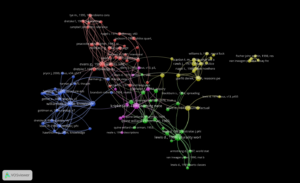 Fig. 2. Overall map (1985-2015).
¶ 24 Leave a comment on paragraph 24 2 We believe that it is possible to recognize the sub-disciplinary structure of analytic philosophy in the clustered structure of the co-citation network. In particular, the red cluster in the northern part of the map includes many documents related to “philosophy of mind”; the yellow eastern cluster could be attributed to “moral and political philosophy”. The southern green cluster could be labeled “metaphysics”. The western light blue one “epistemology”. At the center of the map, several works in the “philosophy of language” can be recognized. Even if these labels should be used cautiously, the overall structure of the map seems patent.
¶ 25 Leave a comment on paragraph 25 4 An interesting feature of the map is the center-periphery relation, which seems to be meaningful. In the center of the map, it seems that one can find the “paradigms” of analytical tradition (Levy 2003), whereas in the periphery we find the specialized sub-disciplines. It seems that the farther one document is located in the map, the more specialized its content is.
¶ 26 Leave a comment on paragraph 26 2 However, we believe that a richer interpretation of the core and periphery of the map is still needed. In particular, we believe it is desirable to connect more properly these findings with substantial meta-philosophical conceptions and theories about the structure of contemporary philosophy.
¶ 27 Leave a comment on paragraph 27 2 Considering the documents shown in the map (i.e., the cited references with more than 20 citations), it seems clear that no “continental” author is present (see Table 2). We can conclude that the so-called analytic-continental divide is still present, at least in the contributions to the journals considered.
| Ranking | Author | Year | Title | Cluster | Label | Links | Co-citations | Citations |
| 1 | lewis d. | 1986 | plurality worlds | 2 | Metaphysics | 80 | 595 | 260 |
| 2 | kripke saul | 1980 | naming necessity | 5 | Philosophy of language | 89 | 552 | 223 |
| 3 | evans g. | 1982 | varieties reference | 1 | Philosophy of mind | 82 | 558 | 176 |
| 4 | quine willard van orman | 1960 | word object | 2 | Metaphysics | 84 | 472 | 172 |
| 5 | williamson t | 2000 | knowledge its limits | 3 | Epistemology | 82 | 467 | 163 |
| 6 | lewis d. | 1973 | Counterfactuals | 4 | Political and moral philosophy | 78 | 327 | 156 |
| 7 | parfit derek | 1984 | reasons persons | 4 | Political and moral philosophy | 64 | 293 | 151 |
| 8 | nozick r. | 1981 | philos explanations | 3 | Epistemology | 86 | 463 | 150 |
| 9 | rawls j. | 1971 | theory justice | 4 | Political and moral philosophy | 61 | 179 | 128 |
| 10 | davidson donald | 1980 | essays actions event | 4 | Political and moral philosophy | 82 | 308 | 110 |
¶ 28 Leave a comment on paragraph 28 0 Table 2: most cited documents (1985-2015).
¶ 29 Leave a comment on paragraph 29 0
- ¶ 30 Leave a comment on paragraph 30 0
- HISTORICAL RECONSTRUCTION
¶ 31 Leave a comment on paragraph 31 0 In this section, we present three science maps, each one based on documents published in the three subsequent timespans we considered. All the maps are co-citation network (see above).
¶ 32
Leave a comment on paragraph 32 0
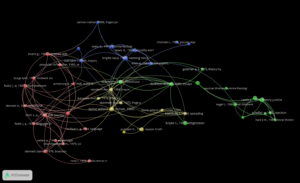 Fig. 3: Map 1985-1994
¶ 33 Leave a comment on paragraph 33 0
¶ 34
Leave a comment on paragraph 34 0
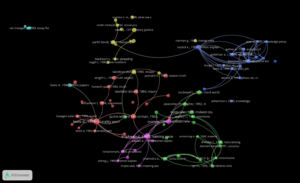 Fig. 4: Map 1995-2004.
¶ 35 Leave a comment on paragraph 35 0
¶ 36
Leave a comment on paragraph 36 0
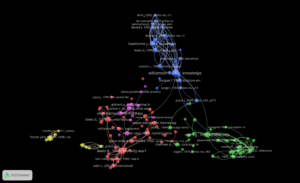 Fig. 5: Map 2005-2015.
¶ 37 Leave a comment on paragraph 37 4 These maps show the morphological evolution of the networks. There is a clear pattern of clusterization of the network over time, with the gradual definition of subclusters. We suggest that this pattern mirrors the increasing specialization of analytic philosophy in the last thirty years, a feature of the field that is perceived by many of its practitioners (Marconi 2014).
¶ 38 Leave a comment on paragraph 38 0
¶ 39 Leave a comment on paragraph 39 0 SECOND CASE STUDY: HUMAN GEOGRAPHY
- ¶ 40 Leave a comment on paragraph 40 0
- DATASET
¶ 41 Leave a comment on paragraph 41 0 Once again, we based our analysis on Web of Science Core Collection. In order to reduce the sample to a manageable size, we selected five generalist[4] journals indicated by Scimago Journal & Country Rank as the highest-quality for the year 2015 (Progress in Human Geography, Global Environmental Change: Human and Policy Dimensions, Transactions of the Institute of British Geographers, Journal of Economic Geography, Economic Geography).
¶ 42 Leave a comment on paragraph 42 0 Documents were again divided in the same three different ten-year timespans (see table 3)
| Ranking | Source | Timespan | Records |
| 1 | PROGRESS IN HUMAN GEOGRAPHY | 1985-1994 | 1136 |
| 1 | PROGRESS IN HUMAN GEOGRAPHY | 1995-2004 | 1332 |
| 1 | PROGRESS IN HUMAN GEOGRAPHY | 2005-2015 | 1080 |
| 2 | GLOBAL ENVIRONMENTAL CHANGE – HUMAN AND POLICY DIMENSIONS | 1985-1994 | 154 |
| 2 | GLOBAL ENVIRONMENTAL CHANGE – HUMAN AND POLICY DIMENSIONS | 1995-2004 | 361 |
| 2 | GLOBAL ENVIRONMENTAL CHANGE – HUMAN AND POLICY DIMENSIONS | 2005-2015 | 1028 |
| 3 | TRANSACTIONS OF THE INSTITUTE OF BRITISH GEOGRAPHERS | 1985-1994 | 667 |
| 3 | TRANSACTIONS OF THE INSTITUTE OF BRITISH GEOGRAPHERS | 1995-2004 | 538 |
| 3 | TRANSACTIONS OF THE INSTITUTE OF BRITISH GEOGRAPHERS | 2005-2015 | 480 |
| 4 | JOURNAL OF ECONOMIC GEOGRAPHY | 1985-1994 | 0 |
| 4 | JOURNAL OF ECONOMIC GEOGRAPHY | 1995-2004 | 99 |
| 4 | JOURNAL OF ECONOMIC GEOGRAPHY | 2005-2015 | 523 |
| 5 | ECONOMIC GEOGRAPHY | 1985-1994 | 518 |
| 5 | E ECONOMIC GEOGRAPHY | 1995-2004 | 443 |
| 5 | ECONOMIC GEOGRAPHY | 2005-2015 | 428 |
| 1-5 | TOP FIVE | 1985-2015 | 8787 |
¶ 43 Leave a comment on paragraph 43 0 Table 3: the dataset.
¶ 44 Leave a comment on paragraph 44 0
- ¶ 45 Leave a comment on paragraph 45 0
- OVERALL MAP
¶ 46 Leave a comment on paragraph 46 2 The whole dataset (1985-2015) was converted into the first map (overall map). In this second case study, we tested a slightly different approach, analyzing the recent evolution of the main research themes in the discipline of human geography via term maps. Terms (noun-phrases) serve as the node of the network, while the distance between the two terms represents the number of their co-occurrences. Terms appearing closer in the map have high co-occurrence values, meaning that they are frequently coupled in titles and abstracts of target documents.
¶ 47 Leave a comment on paragraph 47 0
¶ 48
Leave a comment on paragraph 48 0
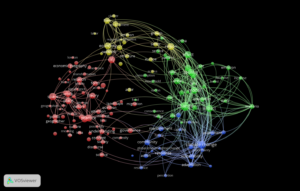 Fig 6: overall map.
¶ 49 Leave a comment on paragraph 49 0 The thematic structure of contemporary research in geography is easily readable in the map. Specifically, four main clusters are recognizable. The yellow cluster in the northern part of the map represents the sub-discipline of “economic geography”, the red cluster in the western part stands out as “social geography”, while the eastern cluster colored in green is representative of the “environmental geography” field. The last one, colored in blue, represents the field of the geography of climate change.
¶ 50 Leave a comment on paragraph 50 0 A compelling feature of the map is the absence of a real center. The four clusters gravitate around autonomous centroids, with different levels of integration with each other: the resultant structure is donut-shaped, showing, therefore, the lack of a real thematic center in the broad discipline.
| item | cluster | Label | Links | Citations | Avg. pub. Year |
| change | 2 | 145 | 1591 | 2005 | |
| climate change | 3 | 143 | 1307 | 2008 | |
| space | 1 | 143 | 1063 | 2005 | |
| impact | 2 | 145 | 1032 | 2007 | |
| city | 1 | 143 | 1009 | 2004 | |
| practice | 1 | 145 | 975 | 2007 | |
| region | 4 | 145 | 954 | 2006 | |
| economy | 4 | 145 | 926 | 2004 | |
| model | 2 | 145 | 922 | 2005 | |
| country | 2 | 145 | 902 | 2006 |
¶ 51 Leave a comment on paragraph 51 0 Table 4: Most cited items.
¶ 52 Leave a comment on paragraph 52 0
- ¶ 53 Leave a comment on paragraph 53 0
- HISTORICAL RECONSTRUCTION
¶ 54 Leave a comment on paragraph 54 0 In this section, we turn again to the historical reconstruction, presenting three maps, each of them based on documents published in the three timespans we considered. All the maps are term-networks.
¶ 55 Leave a comment on paragraph 55 0
¶ 56
Leave a comment on paragraph 56 0
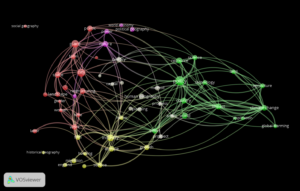 Fig 7: Map 1985-1994.
¶ 57
Leave a comment on paragraph 57 0
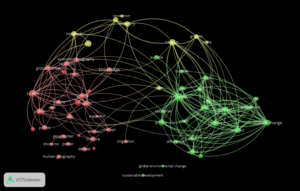 Fig 8: Map 1995-2004.
¶ 58
Leave a comment on paragraph 58 0
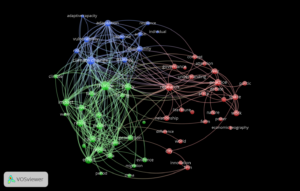 Fig 9: Map 2005-2015.
¶ 59 Leave a comment on paragraph 59 0
¶ 60 Leave a comment on paragraph 60 0 The main aim of these maps is – once again – to show the morphological evolution of the networks. Even in this second case study, there is a clear pattern of clusterization over time, with the gradual definition of subclusters: particularly notable, in this sense, is the gradual formation of the cluster of “climate change geography”. We believe that such a trend is coherent with the evolution of the recent subfields of geography.
¶ 61 Leave a comment on paragraph 61 0
¶ 62 Leave a comment on paragraph 62 0 MAIN LIMITS OF SCIENCE MAPPING APPLIED TO HUMANITIES
¶ 63 Leave a comment on paragraph 63 0 Science mapping allows us to visualize the production of knowledge from a new and different perspective, but it is subject to some limitations that must be taken into account for anyone who wants to employ such a methodology.
¶ 64 Leave a comment on paragraph 64 0 First, the Web of Science database does not include monographs. But monographs are still one of the most common forms of publication in the humanities; hence, their absence reduces the scope of the samples sensibly. However, it is crucial not to misunderstand this point. The lack of monographs in WoS means that references cited in monographs are not counted in the index, not that monographs do not appear at all in the index. Indeed, monographs do appear in so far as the citing articles contain citations pointing to them. Therefore, monographs are part of the set of cited items, but are not part of the set of citing items of WoS
¶ 65 Leave a comment on paragraph 65 0 Secondly, the accessibility of the Web of Science database is variable: in our case, we set Web of Science’s Core collection as the foundation of the bibliographical analysis, excluding the extended collection, that presents a broader scope and longer temporal coverage but lacks any citational information.
¶ 66 Leave a comment on paragraph 66 0 Specifically, the University of Milan’s edition granted us full access to:
- ¶ 67 Leave a comment on paragraph 67 0
- Science Citation Index Expanded (1985-present)
- Social Sciences Citation Index (1985-present)
- Arts & Humanities Citation Index (1985-present)
- Conference Proceedings Citation Index-Science (1990-present)
- Conference Proceedings Citation Index- Social Science & Humanities (1990-present)
- Book Citation Index-Science (2005-present)
- Book Citation Index- Social Sciences & Humanities (2005-present)
- Emerging Sources Citation Index (2015-present)
¶ 68 Leave a comment on paragraph 68 0 Lastly, Web of Science’s subject categories are inaccurate in the case of humanities – sometimes misplacing journals and articles –, and hence they should not be used as accurate means for field delineation.
¶ 69 Leave a comment on paragraph 69 0
¶ 70 Leave a comment on paragraph 70 0 FURTHER RESEARCH
¶ 71 Leave a comment on paragraph 71 0 In conclusion, we advance some further directions of research.
¶ 72 Leave a comment on paragraph 72 4 Concerning philosophy, in the future we would like to map other areas of philosophy, beyond analytic philosophy. Second, we would like to extend the overall timespan, reducing the single intervals, in order to gain a more fine-grained historical reconstruction. Third, we would like to compare our maps with the qualitative assessment of the field experts. Finally, we would like to apply science mapping to the issue of inter-disciplinarity: can we map citational relations between philosophy and sciences? Philosophy of mind would be an interesting case study, in this respect.
¶ 73 Leave a comment on paragraph 73 0 Regarding geography, a possible future direction of inquiry involves mapping the smaller subfields (such as the geography of science, the geography of natural hazards, environmental policies, and so on). A second compelling question is whether or not human geography entails citational relationships with physical geography (Lave 2015). Third, we want to compare our maps with the qualitative assessment of the field experts, and lastly, we want to explore how this mapping approach fares in the analysis of Italian geographical literature.
¶ 74 Leave a comment on paragraph 74 0
¶ 75 Leave a comment on paragraph 75 0 REFERENCES
¶ 76 Leave a comment on paragraph 76 0 Eck, Nees Jan van, and Ludo Waltman. 2010. ‘Software Survey: VOSviewer, a Computer Program for Bibliometric Mapping’. Scientometrics 84 (2): 523–38. https://doi.org/10.1007/s11192-009-0146-3.
¶ 77 Leave a comment on paragraph 77 0 Lave, Rebecca. 2015. ‘Exploring the Proper Relation between Physical and Human Geography: Early Work by John E. Thornes and Ron Johnston’. Progress in Physical Geography 39 (5): 687–90. https://doi.org/10.1177/0309133315595727.
¶ 78 Leave a comment on paragraph 78 0 Levy, Neil. 2003. ‘Analytic and Continental Philosophy: Explaining the Differences’. Metaphilosophy 34 (3): 284–304. https://doi.org/10.1111/1467-9973.00274.
¶ 79 Leave a comment on paragraph 79 0 Marconi, Diego. 2014. Il Mestiere Di Pensare: La Filosofia Nell’epoca Del Professionismo. Vele 91. Torino: Giulio Einaudi editore.
¶ 80 Leave a comment on paragraph 80 0 Petrovich, Eugenio, and Valerio Buonomo. 2018. ‘Reconstructing Late Analytic Philosophy. A Quantitative Approach’. Philosophical Inquiries 6 (1). https://doi.org/10.4454/philinq.v6i1.184.
¶ 81 Leave a comment on paragraph 81 0
¶ 82 Leave a comment on paragraph 82 0 NOTES
¶ 83 Leave a comment on paragraph 83 0 [1] A more detailed analysis of similar data is presented in (Petrovich and Buonomo 2018), along with a substantive discussion of the methodological issues involved and the theoretical background.
¶ 84 Leave a comment on paragraph 84 2 [2] Journals publishing in specialist fields such as philosophy of science or logic are not taken in consideration in this study.
¶ 85 Leave a comment on paragraph 85 0 [3] We used the default value of resolution for the clusterization algorithm (1.00).
¶ 86 Leave a comment on paragraph 86 0 [4] Despite the high score recorded in Scimago database, The Journal of Travel Research is not taken in consideration in this study due to the narrow focus on tourism and travel.

 Alessio Bucci
 Eugenio Petrovich

 Nicola Ruschena

 Emiliano Tolusso
 Sebastiano Moruzzi
Comment awaiting moderation